



Thought for the Month – Jun 2026
“Othering”
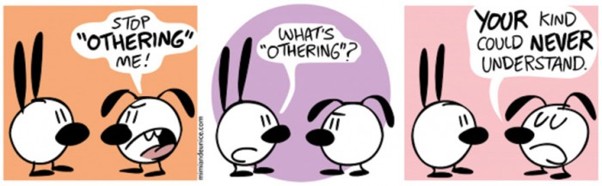
Othering is the act of treating or perceiving individuals or groups as fundamentally different, alien, and separate from oneself or the dominant social “norm.” It creates an “us versus them” mindset, which can lead to prejudice, discrimination, and the marginalization of those perceived as outsiders (Oxford Dictionary – First recorded use c1860)
Open any newspaper, watch a news broadcast, scroll through social media posts, or even think about any recent conversations you yourself may have had (always a little uncomfortable I know) and you are sure to find examples of ‘othering’.
It is striking how quickly human beings learn to divide the world into “us” and “them”. We may not use those words out loud, but the instincts are there: my kind of people and not my kind; people I feel at ease with and people I quietly keep at arm’s length. Sometimes the categories are obvious – nationality, race, class, politics, church tradition. Sometimes they are far subtler such as those who are fun extroverts and those who are boringly reserved, or those who drive cleaner electric vehicles and those who do not. However politely we behave, many of us carry an inner seating plan that decides who belongs at our table – and who does not.
The Gospels show that this is nothing new. In Jesus’ time the social boundaries were religious, ethnic and moral. There were the “righteous” and the “sinners”; the children of Israel and the Samaritans; the clean and the unclean. What is shocking is not that such divisions existed, but how deliberately Jesus ignored them. He eats with tax collectors and prostitutes. He touches those that others will not. He allows women, children, foreigners and the chronically unwell to interrupt him and change his plans. He tells stories in which the supposedly “outsider” like the Good Samaritan, the grateful leper or the prodigal son, becomes the true neighbour, the one whose heart and actions demonstrate the true nature of God’s love.
At the heart of the Christian faith is the conviction that in Jesus Christ, God has shown that He refused to “other” us. St Paul wrote “While we were still sinners, Christ died for us”, Jesus did not wait until we were suitably improved or when we had learnt to behave nicely, but instead while we were still far off. The cross is God’s declaration that there is no human being beyond the scope of his love, no group that can be written off as irredeemable, no life that does not matter. This is why the New Testament speaks of a new humanity being formed in Christ, where “there is no longer Jew or Greek, slave or free, male and female; for all of you are one in Christ Jesus.” The differences do not disappear, but they are no longer reasons to exclude.
Yet the habit of “othering” runs deep. It can sit within our politics, our social media comments, our gossiping and even our church life. We speak as if “those people” – the ones who vote differently, worship differently, or see the world differently – they are the problem, never us. We reduce people to a label or a position, and once we have done that, it is easier to ignore their story, their grief, anger and hopes. It is easier to mock than to listen; easier to condemn than to embrace the complexity of another person’s life. The danger is this, that without even noticing, we become the very Pharisees we read about in the Gospel: confident that we are defending what we think is right, but also quietly standing at a distance from the very people that Jesus is forever walking towards.
What might it look like, for this month as a start, to resist the urge to “other”? Perhaps it begins not with grand gestures, but with very ordinary choices. Choosing to speak of people in terms that respects their humanity, even when we disagree strongly. Choosing to listen a little longer and a lot less judgemental, before we ourselves respond. Choosing to talk to the person who looks out of place at coffee after the service. Try praying not only for “the church, the world and ourselves” in the abstract way we so often do, but to pray for the particular individuals we find difficult to associate with, asking God to bless them, and also soften us. Through prayer we invite the Holy Spirit to show us where fear, pride or dislike, have led us to quietly shut the door on others, thus providing us with the opportunity to change.
Jesus never pretended differences did not matter. He confronted injustice, named sin and called people to change. But he did so while drawing people in, not pushing them away. He refused to let anyone be reduced to the worst thing they had done, or to the label others had pinned on them. If we are to be his body in the world, then the universal church that should dwell within us all, must become the one place where “us and them” is being slowly, patiently unlearned – where enemies are prayed for, strangers are welcomed, and those who feel most on the edge, discover, to their surprise, that there is room at the table for them. “Love one another as I have loved you”, He said.
So, your ‘thought for the month’ might be as simple and also as demanding as this: to ask yourself, “is there one person or group I have quietly othered”? And “what one small step could I take, with God’s help, to move a little closer to them rather than a little further away”? Amen.
Dear Father and Creator of all,
We thank you for the astonishing variety of races, cultures, beliefs and backgrounds that make up our world. In your wisdom, you designed this rich diversity as a reflection of your grace.
Help us to acknowledge our differences—not as reasons to divide us, but as gifts that make our communities vibrant and whole. Forgive us for the times we have let fear or misunderstanding turn our differences, our assumptions and our dislikes into a hardening of our hearts.
Grant us the courage to look beyond the surface and recognize our shared humanity. Open our hearts to listen, our minds to learn, and our bodies to create inclusive spaces where every person is valued.
Unite us all, friend or adversary, in a spirit of harmony, where love is our common language and difference is our greatest strength.
Amen.
Danny